A Normie Runner's Review of Runna
TLDR: It's probably worth the subscription.
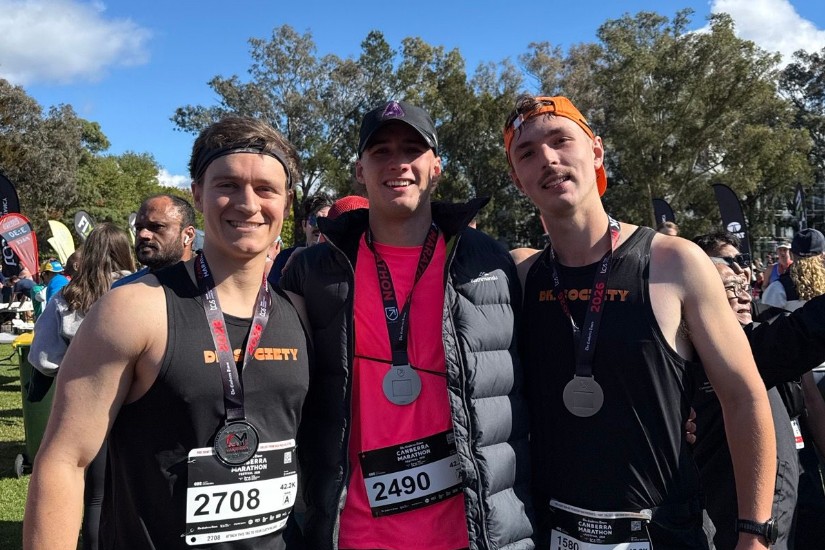
I was quite on the fence about paying for Runna when I signed up for to train for my thrid marathon; I hope this review will help other decided whether or not to purchase a subscription.
(TL;DR: I think it’s worth it.)
Running History
I’ve run two previous marathon. For each marathon, I spent about 15 weeks training. My training plan was dead simple - I’d figure out what target time I wanted, and google “16 week <target time> marathon training plan”, find one with a printable PDF, and tape it to the wall in my room. Then I’d try just do the mileage each day. I didn’t differentiate between easy runs, workout, tempo, or even do warm up/cool down laps. I kinda just got out there each morning and tried to run the miles for the day at a pace I felt was respectable while also not going too hard so as to make it completely unenjoyable.
Inputting Data
When you sign up for a subscription, Runna asks you to input some info.
Race Details
It asks if you’re preparing for a certain race. I searched for and selected the Canberra Marathon. It then imports info about the race, such as date and elevation profile.
Training Preferences
- How many days per week are you willing to run?
- I entered 6.
- How fast are you currently?
- You enter this by entering a recent distance you ran and the time it took. I entered my last marathon time of 3:27 in October 2024.
- Which day do you want to be a rest day?
- I figured the middle of the week was practical; I entered Wednesday.
- Which day do you want to be a long run day?
- I entered Saturday.
Current Running Ability
There’s four options:
- Beginner: You can complete a 3 mile run without stopping, in under 60 minutes.
- Intermediate: You regularly run at least 3 mile but don’t structure your training or put thought into a plan.
- Advanced: You regularly run at least 6 miles and do some structured training e.g. intervals.
- Elite: You regularly run half-marathons or further and are experienced with structured training e.g. intervals.
I chose Advanced.
The Plan
Runna used this info to crate a plan for every week up to the day of the marathon. Most weeks it looked the same:
| Day | Type |
|---|---|
| Mon | Easy Run |
| Tue | Workout (Tempo or Intervals) |
| Wed | Rest |
| Thurs | Workout (Tempo or Intervals) |
| Friday | Easy Run |
| Saturday | Long Run |
| Sunday | Easy Run |
As the plan the progresses, the pace for each run gradually increases for every type of run (though the Easy Runs are always at a “no faster than” pace). Also, the app inserted two deload weeks where the mileage and intensity was lower.
Before you even being the plan, Runna predicts your race time given that you adhere to its plan. For me, it predicted a 3:23 marathon time. I felt since my last marathon was 3:27, I should be able to hit a faster time, so I went it back and told it that rather than running a 3:27 marathon in October 2024, I actually ran a 3:27 the previous week. This made it then predict a time around 3:17.
Features
Dynamic Training Plan
The app analyzes how your runs are going and makes adjustments to the plan. After about a month, it noticed that I was consistently completing laps in my workouts faster than the target pace, so it asked whether I wanted to re-create my training plan to slightly increase the intensity. I accepted its suggestion.
My routes would often add 1-3 extra kilometers beyond what Runna set for my daily run, so it also began asking if I wanted to increase my weekly mileage. I declined this suggestion because I figured my new routes would also not be the perfect distance, and I wanted to keep my mileage at a sustainable amount.
I did like this feature a lot. By the end of my training, I would miss my pace target sometimes for some of the laps on workouts. I think this was good thing, as I knew it was pushing me to go harder but not to any pace that was unrealistic.
If you need to rearrange your schedule, you can do this easily in a training plan calendar view on the app.
The App
The app interface is clean. Intuitive and easy to use.
The voice coach during Tempo and Interval workouts is helpful. During each lap, it tell you what pace to go at and if you’re going too fast or too slow. Occasionally it seemed a bit off, telling me I was going much to fast and then shortly after telling me I was going too slow, but this didn’t happen frequently enough to be a real issue.
Conveniently, the app links to Strava. Every time you save the run in Runna, you can check a box to upload it to Strava. This also works vice-versa. For example, you can record a run on your watch, upload it to Strava, and then it will appear in Runna.
I also liked that it made doing runs on treadmills easy - it would tell you exactly which speed to set the treadmill at and when to change it.
Results
I was hoping for a sub 3:20; I got a 3:25.
| Year | Age | Time (HH:MM) | Weight (lbs / kg) | Elevation Gain (m) | Elevation (m) |
|---|---|---|---|---|---|
| 2017 | 18 | 03:59 | 150 / 68.0 | 250 | 0 |
| 2024 | 25 | 03:27 | 170 / 77.1 | 298 | 0 |
| 2026 | 27 | 03:25 | 181 / 82.1 | 298 | 578 |
At the beginning I was feeling great, and stuck with the 3:15 pacer for the majority of the race. But in the last 10k my gut started feeling terrible, and I began to feel considerably worse than I did during the past two marathons. My pace dropped significantly at that point.
But despite the elevation1, the sneaky hills2, gaining 11 lbs, and feeling terribly internally, I still managed a PB, so I guess that means the training was doing something right.
Final Thoughts
Alex Hutchinson’s book Endure discusses many of the factors that affect human endurance. One of the least understood but no doubt significant factor is belief in one’s ability to endure. For this reason, I think one of most valuable aspects of Runna is the confidence you gain from a structured plan. There were multiple times during the training when I would see the pace targets for laps before beginning the workout and wonder whether I could really hit them. But I’d figured that Runna may know my running ability better than myself. So I’d start the workout, and more often than not, I would hit the pace targets.
On race day, I spent more than the first half of the race with the 3:15 pacers. In the end I had to slow down considerably, but I have a feeling that if I didn’t have any gut issues I would’ve been able to hold that pace for a lot longer than I did. If I didn’t use the Runna app, I would never have considered going out with the 3:15 pacer, but Runna was predicting a time of 3:15:43, so I believed I had a shot.
Could I have made my own custom, dynamic training plan for free using AI? Probably. But I don’t think I would have had the same confidence in it, and therefore I don’t think it would have been as effective.
As I write this, you can bundle a Strava + Runna subscription for $12.50 USD per month, which means a four month training plan is $50. Definitely worth it for a PB and being able to offload all the effort of curating a training plan to an app.
I learned something interesting from the book Endure: Canberra sits at about 578 meters above sea level. Conventional sports science wisdom thought you needed to be at least 1000 meters above sea level before the difference in oxygen had any significant effect on performance, but when the Australian Institute of Sport was built in Canberra, it found that its measurements of VO2 max in pro athletes were significantly lower than previously measured in the athletes. It was thought that the machines were faulty, but after more testing, the culprit was found to be the elevation of Canberra. ↩︎
The previous two marathons I did were both the Marine Corps Marathon in Washington DC. The Canberra Marathon felt way hillier. ↩︎